
The newer UGR glare rating according to CIE 190:2010 is widely used in France and is also referred to in the WELL building certification standards. Over the years, Viso clients have asked for this method as an alterntive to the more widely used CIE 117:1995 that is standard in Viso software and reports. And now it has become available.
In the software – UGR 190:2010 and UGR 117:1995
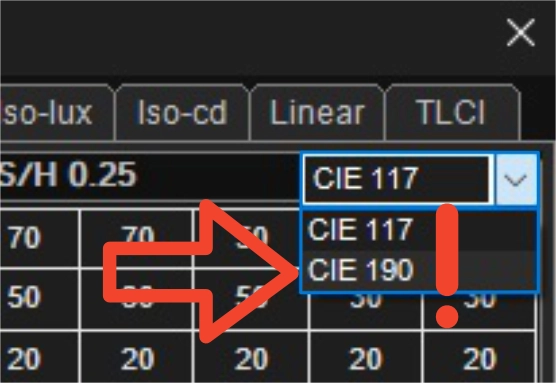
- Go to View > CIE/UGR/BUG…> Tab: UGR
- Find the drop-down list in the upper right-hand corner
- Choose between CIE 190 and standard CIE 117 results.
Want to know more UGR and glare? Watch this 9-minute crash-course video.
In PDF reports – UGR 190:2010 and UGR 117:1995
Use {KEYWORDS} to indicate the desired output. Reuse a table from an existing report instead of starting from scratch.
- Use {UGR190_TABLE_START} instead of the standard {UGR_TABLE_START} to start a new UGR CIE 190 table
- Fill table with repeated {V} keywords to fill table values.
- Use {UGR190_TABLE_END} instead of the standard {UGR_TABLE_END} to end a new UGR CIE 190 table
- Use {UGR190_4H8HC} instead of the standard {UGR_4H8HC} to extract specifically the 4H8H value crosswise.
- Use UGR190_4H8HL}{UGR_4H8HL} to extract specifically the 4H8H value lengthwise.
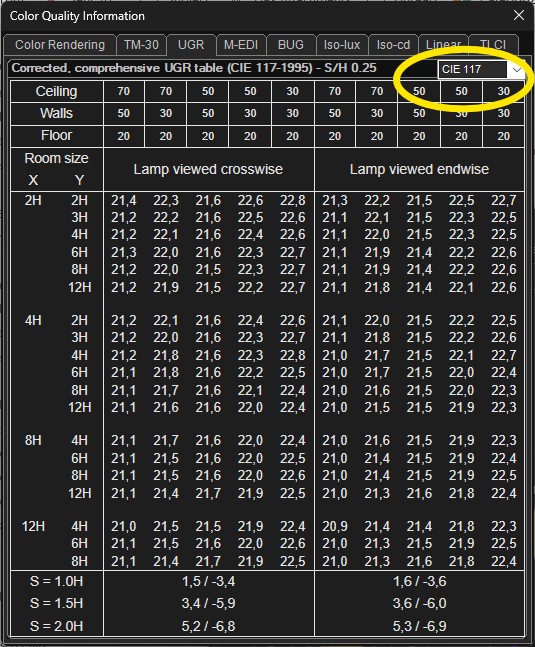
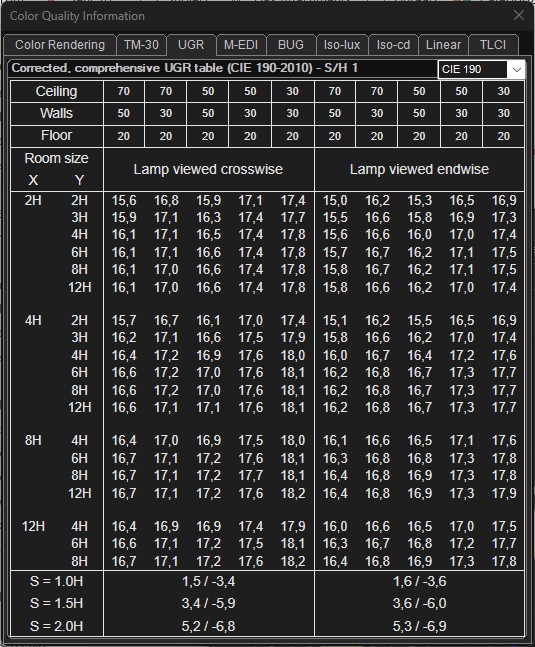
Example outputs:
The near future: UGR according to CIE 232:2019
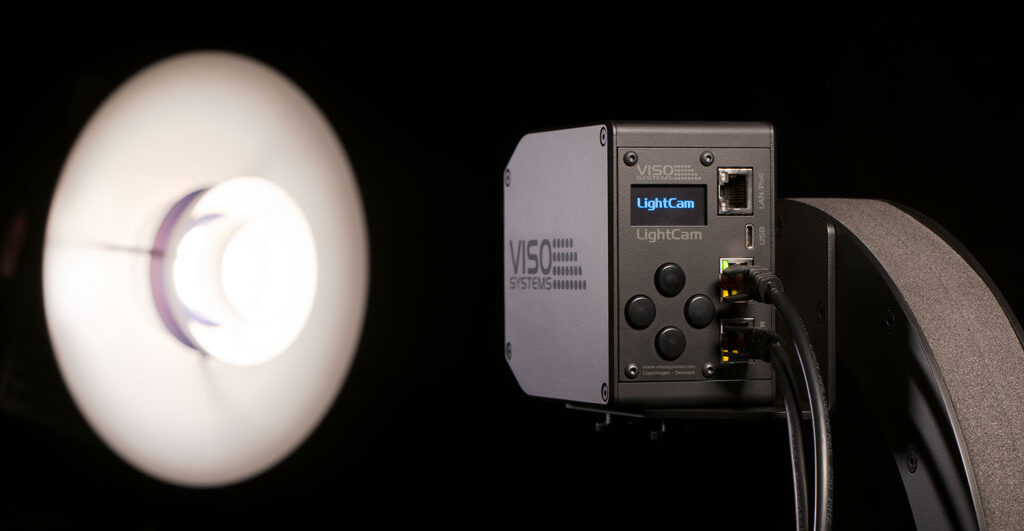
With the upcoming Viso LightCam, you will even be able to get UGR 232. Read more about LightCam here.
CIE 232 addresses an important flaw in traditional UGR calculations. Traditionally, all parts of the luminous surface were given equal weight, assuming an average luminance was a good approximation of the actual luminance distribution. This may have been true in the days of fluorescent sources and matte incandescent bulbs. However, the LED revolution quickly demonstrated, both scientifically and intuitively, that a light source consisting of many small LED dots produces much more glare than a totally diffuse panel. In other words, the older CIE 117 and CIE 190 formulas grossly underestimated the glare of some LED solutions, especially those with exposed LEDs.
Therefore, CIE 232 introduces a uniformity correction factor based on the size of the luminous surface, which consequently affects the luminance.
The uniformity correction factor
To calculate the correction factor, the luminance distribution is considered at two angles relative to the vertical plane: 65° and 50°. These angles represent typical overhead lighting viewing angles in office spaces. Ideally, all relevant viewing angles would be considered, but these two angles were chosen to simplify practical measurements and analyses.
Such a luminance distribution can only be captured with a luminance camera. Such cameras are not standard equipment in light measurement labs. A luminance camera captures calibrated images of light intensity per area unit [cd/m2] – colloquially, “brightness.”
The CIE 232 methodology only considers areas where the luminance is higher than 500 cd/m². The effective luminance is calculated as the average over these specific areas, and a correction parameter k is defined.
Here Ls is the average source luminace and ω is the solid angle of the source area (proxy for the “size”), and Leff and ωeff are the corresponding parameters pertaining to the effective area. This factor is then used to correct the old UGR formula defined in CIE 117:
The factor effectively replaces the values above the division line with a new definition of the observed surface area and average luminance, which is now calculated for values of 500+ cd/m² only.
How will Viso Systems and LightCam contribute?
LightCam will capture luminance/radiance distributions in all viewing directions, but making a series of luminance images from all the same angles as your normal light measurement. Use these luminance videos to work more scientifically with glare by analyzing and comparing different optical solutions.
Viso Light Inspector will include automatic CIE 232 calculations.
Read more about the new LightCam addition to Viso LabSpion and BaseSpion systems here.